
Anúncios
Weather forecasting apps have become essential tools in our daily lives, helping millions of people plan their activities with confidence and stay safe during severe weather conditions.


Gone are the days when we relied solely on television broadcasts or radio updates to know if we needed an umbrella. Modern weather applications deliver hyperlocal forecasts, real-time alerts, and interactive radar maps right to our smartphones, transforming how we interact with atmospheric data.
Anúncios
The evolution of meteorological technology has empowered everyday users with information that was once accessible only to professionals. Whether you’re a farmer planning harvest schedules, a traveler organizing a vacation, or simply someone deciding what to wear, weather apps have become indispensable companions in navigating our climate-dependent world.
🌤️ The Technology Behind Modern Weather Forecasting Apps
Weather prediction applications rely on sophisticated networks of data collection systems scattered across the globe. Satellites orbiting Earth continuously photograph cloud formations and measure atmospheric temperatures, while ground-based weather stations record local conditions including humidity, wind speed, and barometric pressure.
Anúncios
These data streams feed into powerful supercomputers that run complex mathematical models simulating atmospheric behavior. The models divide the atmosphere into three-dimensional grids, calculating how air masses, moisture, and temperature will change over time. This computational process happens continuously, updating forecasts every few hours as new observational data arrives.
Machine learning algorithms have recently revolutionized forecast accuracy by identifying patterns human meteorologists might miss. These systems analyze historical weather data alongside current conditions to refine predictions, particularly for localized phenomena like afternoon thunderstorms or coastal fog patterns.
Data Sources That Power Your Weather App
Professional weather services aggregate information from multiple authoritative sources. The National Weather Service, European Centre for Medium-Range Weather Forecasts, and similar agencies worldwide contribute their governmental-grade data to commercial applications.
Crowdsourced information has also become valuable, with some apps collecting temperature and pressure readings from users’ smartphones to supplement official stations. Personal weather stations owned by enthusiasts add hyper-local detail that government networks can’t match in density.
📱 Essential Features Every Quality Weather App Should Offer
The best forecasting applications balance comprehensive information with intuitive design. A cluttered interface overwhelms users, while oversimplified displays leave important questions unanswered. Finding that sweet spot separates exceptional apps from mediocre ones.
Hourly forecasts extending at least 48 hours ahead give users the granular detail needed for planning specific activities. Knowing that rain will start at 3 PM rather than just “afternoon showers” makes the difference between a ruined picnic and a perfectly timed outdoor event.
Interactive radar maps with animation capabilities let users visualize approaching weather systems. Watching a storm’s movement helps determine whether it will pass north of your location or deliver a direct hit, information static forecasts can’t convey as effectively.
Alert Systems That Keep You Safe
Push notifications for severe weather warnings serve a critical safety function. Tornadoes, flash floods, and extreme temperature events can develop rapidly, and timely alerts provide precious minutes to seek shelter or take protective action.
Customizable alert thresholds prevent notification fatigue. Users in Florida might want alerts for any tropical system, while someone in Arizona cares more about dust storm warnings. Quality apps let you tailor which conditions trigger notifications for your location.

🌍 Global Coverage vs. Hyperlocal Accuracy
International travelers need apps that maintain reliability across borders. While some applications excel in their home countries, forecast quality deteriorates dramatically in regions where they lack data partnerships or localized modeling.
The concept of “hyperlocal” forecasting has gained prominence as users demand precision for their exact neighborhood rather than city-wide predictions. Microclimates created by terrain, bodies of water, or urban heat islands can produce significantly different conditions just miles apart.
Apps achieving hyperlocal accuracy typically combine multiple forecast models, weight them based on historical performance for specific locations, and integrate real-time observations from dense station networks. This computational approach delivers predictions accurate to specific zip codes or even street addresses.
Understanding Forecast Limitations
Even the most advanced applications face inherent meteorological limits. Forecast accuracy degrades with time – tomorrow’s prediction will always be more reliable than next week’s. The atmosphere is a chaotic system where small measurement errors compound into large uncertainties over extended periods.
Certain weather phenomena remain particularly challenging to predict. Exactly where a thunderstorm will form on a summer afternoon involves variables too small-scale for current models to resolve perfectly. Snow-rain boundaries during winter storms can shift just a few miles, dramatically changing impacts.
⚡ Specialized Forecasts for Specific Activities
Beyond basic temperature and precipitation, modern apps cater to niche interests with specialized indices and forecasts. Outdoor enthusiasts, athletes, and health-conscious individuals all have unique weather information needs that general forecasts don’t address.
UV index predictions help people protect their skin during outdoor exposure. Pollen counts assist allergy sufferers in planning medication and outdoor activities. Air quality forecasts have become crucial in regions affected by wildfires or industrial pollution.
Marine forecasts serve boaters with wave heights, water temperatures, and small craft advisories. Aviation weather caters to pilots with turbulence predictions, icing levels, and visibility forecasts. Agriculture-focused apps provide growing degree days, frost probabilities, and field condition estimates.
Astronomical and Outdoor Recreation Features
Stargazers appreciate cloud cover forecasts paired with moon phase information and astronomical event notifications. Photographers seek “golden hour” timing combined with cloud predictions for optimal lighting conditions.
Hikers and campers benefit from wilderness-specific forecasts that account for elevation changes and remote locations far from weather stations. These specialized predictions often incorporate topographic data to model how mountains and valleys influence local weather patterns.
🔒 Privacy Considerations in Weather Applications
Weather apps necessarily access your location to provide relevant forecasts, but not all handle this sensitive data responsibly. Some applications track users far more extensively than forecasting requires, building detailed profiles of movement patterns and behaviors.
Reading privacy policies reveals which apps sell user data to advertisers or third parties. Location history, combined with other information, can expose surprisingly personal details about routines, home addresses, and frequently visited places.
Privacy-conscious users should look for apps offering manual location entry rather than continuous GPS tracking. Background location access particularly deserves scrutiny – most forecasting apps work perfectly well checking your location only when you open them, not continuously throughout the day.
💡 Battery Life and Data Usage Optimization
Weather apps that constantly refresh forecasts and run background processes can significantly impact smartphone battery life. Animations, live radar updates, and persistent GPS tracking drain power faster than static displays and periodic updates.
Adjusting refresh intervals balances current information against energy consumption. Checking conditions every five minutes rarely provides meaningful new information, while hourly updates keep forecasts reasonably current without excessive battery drain.
Data consumption becomes important for users with limited cellular plans or when traveling internationally. High-resolution radar maps and frequent automatic updates consume substantial bandwidth. Apps offering offline mode or reduced data settings help manage usage without sacrificing core functionality.
🎨 Design Philosophy and User Experience
The visual presentation of weather information significantly affects usability. Some apps embrace minimalist designs with large, clear typography showing only essential information at a glance. Others pack screens with charts, graphs, and detailed metrics appealing to weather enthusiasts who want comprehensive data.
Color schemes should enhance readability rather than merely looking attractive. High contrast between text and backgrounds improves outdoor visibility when sunlight washes out screens. Colorblind-friendly palettes ensure radar maps remain interpretable for all users.
Widget design brings weather information directly to home screens without opening the full app. Well-designed widgets display current conditions and upcoming forecasts in compact, attractive formats that update automatically throughout the day.
Accessibility Features That Matter
Voice assistant integration lets users ask about weather conditions hands-free while driving or cooking. Screen reader compatibility ensures visually impaired users can access all forecast information through audio descriptions.
Text sizing options accommodate users with vision limitations, while simplified modes reduce cognitive load for those who find dense data presentations overwhelming. Truly inclusive design considers the full spectrum of user abilities and preferences.
📊 Comparing Accuracy Across Popular Weather Apps
Independent studies evaluating forecast accuracy reveal significant performance differences between weather applications. Surprisingly, price doesn’t always correlate with quality – some free apps outperform premium alternatives in accuracy tests.
Temperature predictions generally prove most reliable, with top apps achieving accuracy within two degrees Fahrenheit for next-day forecasts. Precipitation probability shows more variance between services, reflecting the inherent difficulty of predicting exactly where rain will fall.
No single app proves most accurate everywhere. Regional strengths emerge based on which forecast models and data sources each application prioritizes. An app excelling in North America might underperform in Asia if it lacks strong data partnerships there.
Crowdsourced Accuracy Verification
Some weather services invite users to report actual conditions, creating feedback loops that identify systematic biases. When an app consistently overpredicts rainfall in certain regions, this crowdsourced verification helps meteorologists adjust their models.
Community-driven weather networks where users operate personal weather stations contribute valuable ground truth data. These observations help apps calibrate their forecasts against real-world conditions rather than relying solely on official weather station networks.
🚀 Future Innovations in Weather Forecasting Technology
Artificial intelligence continues advancing forecast accuracy, particularly for nowcasting – predictions covering the next few hours. Neural networks trained on radar imagery can predict storm evolution with impressive precision over short timeframes.
Satellite technology improvements provide higher resolution imagery more frequently. Next-generation weather satellites scan entire hemispheres every few minutes rather than hourly, capturing rapidly developing weather systems that older satellites missed between observations.
Quantum computing promises revolutionary advances in weather modeling. These powerful systems could simulate atmospheric behavior at much finer resolution than today’s supercomputers, potentially extending accurate forecast windows from ten days to two weeks or beyond.
Augmented Reality Weather Visualization
Emerging AR features overlay weather information onto real-world views through smartphone cameras. Point your device at the sky and see predicted cloud movement, precipitation intensity, or storm tracks superimposed on the actual landscape.
This technology makes abstract forecast data tangible and intuitive. Rather than interpreting radar maps or percentage probabilities, users see visual representations of how weather will affect their immediate environment over coming hours.
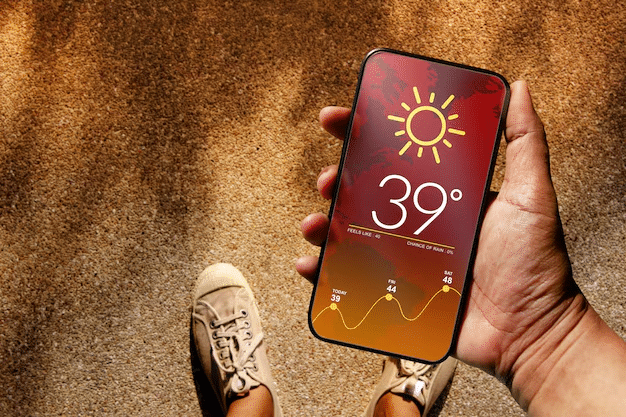
🌟 Choosing the Right Weather App for Your Needs
Personal priorities should guide app selection more than popularity rankings. Casual users checking daily forecasts need different features than storm chasers analyzing detailed meteorological data or outdoor professionals whose safety depends on accurate predictions.
Testing several apps simultaneously for a few weeks reveals which interface feels most intuitive and which forecasts prove most accurate for your specific location. Weather app preference often becomes quite personal, based on individual information needs and aesthetic preferences.
Consider trying specialized apps alongside general-purpose forecasters. A dedicated marine weather app might supplement your primary forecaster if you boat frequently, while a separate air quality app could provide more detailed pollution data than generic weather applications offer.
The ideal weather application delivers the information you need, when you need it, without overwhelming you with unnecessary data or compromising your privacy. As forecasting technology continues improving, these digital meteorologists in our pockets become ever more accurate and helpful in navigating our weather-dependent world.
